English


 English

Views: 0 Author: Site Editor Publish Time: 2026-10-20 Origin: Site


A urology product-line benchmark
Introduction
In ureteroscopy, "better" is the wrong question. A rigid and a flexible ureteroscope are not substitutes — they divide the urinary tract between them.
The rigid (semi-rigid) scope owns the ureter. The flexible scope owns the renal collecting system. This guide compares the two on the metrics that actually change outcomes — stone-free rate, complication risk, operating time, and anatomical reach.
The numbers: what the evidence says
For proximal ureteral stones, flexible wins.
A 2024 meta-analysis (6 studies, 1,085 patients) found:
Stone-free rate — 92% flexible / 84.5% rigid (P less than 0.001)
Complication rate — Comparable
Operating time — Comparable
For stones above the lower renal pole, the gap is wider. In a randomized trial of 92 patients with upper ureteral stones over 10 mm, flexible holmium laser lithotripsy reached 95.7% success versus 80.4% for rigid, with one-month clearance of 83.3% versus 52.9% in the upper-pole subgroup.
But for mid and lower ureter, rigid is faster.
In a 167-patient cohort, semi-rigid scopes delivered higher instant stone clearance (92.4% vs 81.3%) and shorter OR time (44.1 vs 62.1 minutes). Using a flexible scope below the renal pelvis costs roughly 18 minutes per case for no gain in clearance.
Why: anatomy, not technology
The rigid scope has a straight, stable shaft and provides superior irrigation flow and visibility in the linear ureter — but it cannot enter the renal pelvis or navigate a calyx.
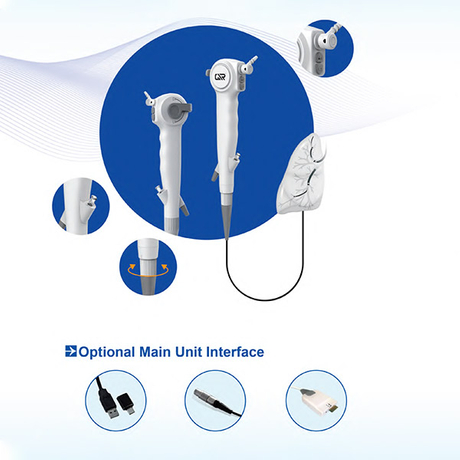
The flexible scope has an actively deflectable tip (270 to 300 degrees), the only way to reach the upper and middle calyces and the lower pole. EAU and AUA list flexible URS as a first-line option for intrarenal stones up to 20 mm.
The trade-off: deflection reduces the working channel, and the laser fiber itself can cause a "laser-induced tip drop." A ureteral access sheath (UAS) is also usually required.
Safety: where rigid scopes carry more risk
This is where honest manufacturers separate themselves from the rest.
Rigid ureteroscopy carries a measurable perforation and stricture risk: ureteral perforation in 4 to 8% of rigid procedures, and a stricture rate of 3.5% overall, rising to 5.9% after perforation.
Flexible scopes reduce this risk by navigating rather than pushing. In a 115-patient study of impacted upper ureteral stones, a flexible navigable suction sheath (FANS) approach cut stricture from 7.7% to 2% and perforation from 6.2% to 2% versus the conventional rigid "stone-pushing" technique.
For impacted stones or a dilated ureter, the flexible scope is not a preference — it is a safety decision.
Access sheaths change the equation
No comparison is complete in 2026 without what happens around the scope.
FANS (Flexible and Navigable Suction Sheaths) materially improve the flexible value proposition:
Stone-free rate — 95% versus 67% at one month
Intrarenal pressure — 20.08 vs 67.43 cmH2O, a more than threefold drop that directly lowers postoperative fever and sepsis risk
Complication rate — 13.5% vs 31.4%
Dual-channel flexible scopes keep outflow — and visibility — open when an instrument is in the working channel. And miniaturization is the quiet winner: smaller scopes lower intrarenal pressure and fit narrower UAS and tight ureters that larger scopes cannot access.
Department-level selection
Clinical scenario — Scope of choice — Why
Mid and lower ureteral stones — Rigid / semi-rigid — Faster, equal SFR, lower cost
Proximal ureteral stones — Flexible — 92% vs 84.5% SFR; reaches above UPJ
Renal pelvis and calyces — Flexible — Only deflectable tip reaches them
Lower pole stones over 20 mm — PCNL first line — EAU or AUA guidance
Impacted stones, dilated ureter — Flexible plus FANS — Avoids pushing; stricture 2% vs 7.7%
Morbidly obese, pelvic or horseshoe kidney — Flexible — fURS is first-line
Immunocompromised or MDR infection — Single-use flexible — Avoids cross-infection
Procurement: a single-scope department loses
The highest-performing departments standardize on both.
Rigid-only means you cannot treat intrarenal stones and accept a 7 to 8% stricture risk on impacted stones. Flexible-only means 18 extra minutes per case in the mid-ureter and a higher per-procedure instrument cost.
The correct configuration is a two-scope urology line:
Rigid or semi-rigid — the high-throughput workhorse for the ureter
Flexible — the precision instrument for the kidney and complex ureter
When both are available, the surgeon selects on anatomy rather than compromise.
What to ask a supplier
What is the tip deflection — and does it hold with a laser fiber inserted?
Outer diameter and working channel size?
Single or dual channel, and what is irrigation flow with an instrument in place?
Digital or fiber-optic imaging?
Compatible UAS range, including 12 or 14 Fr for tight ureters?
Single-use flexible option for high-infection-risk patients?
Laser compatibility — Holmium:YAG, Thulium fiber laser, Moses mode?
Sterilization method and lifecycle for the reusable flexible scope?
OEM or private labeling supported?
Certifications — CE, FDA 510(k), ISO 13485?
Conclusion: buy the pair, not the debate
Rigid and flexible ureteroscopes are not competitors — they are two halves of a complete stone-management service.
The rigid scope is faster, cheaper, and equally effective below the renal pelvis. The flexible scope offers better clearance above the UPJ and is the only option for the calyces.
For hospitals and distributors, the logical move is a paired product line covering the entire tract. For surgeons, it means never choosing the wrong instrument because the right one is unavailable.
Get the full urology product-line specification sheet, configuration options for your department, and a quotation.
Contact Us — Request a Quote — Download Urology Product Catalog PDF