Views: 0 Author: Site Editor Publish Time: 2026-10-20 Origin: Site


For hospital procurement teams, ICU managers, and respiratory device distributors
If you buy bronchoscopes based on price alone, you are almost certainly buying the wrong device. Bronchoscopy today covers far more than "looking inside the airway" — from bedside suction and bronchoalveolar lavage in the ICU, to biopsy and endobronchial therapy in the interventional suite, to double-lumen tube positioning in the operating room. The definition of "easy to use" changes completely with the scenario.
This guide walks through the specifications that actually matter, the real advantages of disposable bronchoscopes, and a simple checklist to use before you sign a purchase order.
Forget the marketing language. When comparing quotations, only these five numbers determine the clinical experience.
Outer diameter — who the scope fits
This is your first filter. ≤Φ2.8mm passes through most endotracheal tubes and works for pediatrics and awake nasal exams. Φ4.3mm is the adult workhorse, balancing channel size with patient tolerance. Φ5.5mm and above is the therapeutic range — larger channels accept biopsy forceps and balloons, but tolerance is lower.
Tip: do not buy one model. A "thin scope + therapeutic scope" combination (2.8mm + 5.5mm) covers more than 90% of clinical scenarios and is more economical than standardizing on a single size.
Working channel — what the scope can do
A Φ1.2mm channel handles suction, lavage, and small forceps. For cryobiopsy, balloon dilation, or large foreign-body forceps, you need ≥2.0mm. Important: the nominal channel value is not the usable value. Ask the supplier for measured data on the largest instrument that actually passes through, and for a full list of compatible consumables.
Bending angle — where the scope can reach
210° up/down is the current high-end standard, letting the tip make a near-U-turn and significantly improving access to the upper lobe apical and posterior segments and B6. Entry-level devices at 160°–180° leave noticeably more blind spots in patients with anatomical variants or postoperative changes.
Imaging — how clearly you can see
160,000 pixels is enough for routine observation. 300,000–500,000 pixels lets you识别 subtle mucosal changes for targeted biopsy. 1,000,000 pixels (1080P) approaches electronic bronchoscope quality and is the choice for interventional and research departments. Pair it with a high-brightness cold light source — cold light avoids thermal tissue injury, which is a non-negotiable safety.
Effective length — where the scope is used
380mm is the bedside length, designed for in-tube operation, ICU suction, and airway management. 650–680mm is the standard examination length, reaching subsegmental branches. A good supplier offers length customization rather than making your department adapt to the product.

The case for single-use is strongest where cross-infection risk is unacceptable.
Zero infection risk. Individually packaged and EO- or irradiation-sterilized, single-use scopes eliminate the protein residue and cross-contamination that come with inadequate reprocessing. This matters most in ICUs, negative-pressure wards, TB and drug-resistant infection units, and immunocompromised patients.
Lower total cost than you think. A disposable scope has no repair cost, no reprocessing consumables, and no downtime. When you add back the cost of a reprocessing unit, dedicated staff hours, and chemical disinfectants, the TCO of a reusable scope is often higher — not lower — than a disposable one.
Faster turnaround. A reusable scope sits in reprocessing for 30–60 minutes; a disposable one is ready the moment a patient deteriorates. In the ICU and emergency department, that difference is measured in lives.
Factor | Single-use | Reusable |
|---|---|---|
Infection risk | None | Depends on reprocessing |
Upfront cost | Unit price × annual volume | Scope + reprocessing equipment + repair fund |
Turnaround | Immediate | 30–60 min per cycle |
Imaging ceiling | Up to 1 MP | Up to 4K |
Large-channel therapy | Limited | Mature ecosystem |
Best fit | ICU, ER, pediatrics, wards | Interventional suite, thoracic surgery |
The practical answer is not "one or the other." Most hospitals do best with a 70:30 or 60:40 split — disposable scopes for diagnosis and bedside work, reusable electronic scopes for complex therapy. That gives you zero infection risk where it matters most, without giving up the imaging and channel capacity you need in the interventional suite.
Most procurement mistakes come from not asking the right questions early. Print this list.
On the specs
Are outer diameter and channel size nominal or measured? Can you show a third-party test report?
Is the 210° angle the maximum mechanical angle or the effective imaging angle?
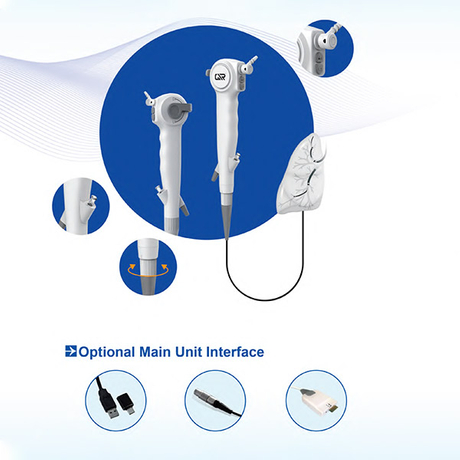
Are the pixels physical or interpolated? What video output do you support — USB, HDMI, CVBS?
Can effective length be customized, and what is the MOQ and lead time?
On compliance
Do you hold valid CE / FDA / ISO 13485 for the target market?
What sterilization method do you use, and is the SAL rated to 10⁻⁶?
Do you provide COA, bioburden, and EO residue reports with every lot?
On commercial terms
What are your MOQ, volume pricing, and annual contract discount?
What is your standard and emergency lead time, and do you hold overseas stock?
Do you support OEM — private labeling, localized packaging, multilingual manuals?
Do you provide clinical training and remote technical support?
ICU / Emergency: Φ5.5mm × 380mm short scope + Φ2.8mm long scope
Respiratory endoscopy center: Φ2.8mm + Φ4.3mm + Φ5.5mm
Pediatrics: Φ2.3mm ultra-thin
Anesthesiology: Φ2.8mm × 650mm for double-lumen tube positioning
Distributors: full range plus OEM customization
A bronchoscope purchase is really a balance of four goals: patient safety, clinical efficiency, infection control, and cost. A single-use bronchoscope is not a cheap substitute — it is a predictable per-use cost that buys you zero infection risk, zero downtime, and consistent imaging quality. For hospitals, that frees up reprocessing capacity. For distributors, the consumable nature means higher-frequency, more stable reorders.
Get the complete specification sheet, target-market certificate package, and OEM/ODM options — plus a free evaluation sample.