


Views: 0 Author: Site Editor Publish Time: 2025-10-13 Origin: Site


Modern medicine relies on precision, clarity, and minimally invasive solutions. Among these innovations, 4K Endoscope Camera Systems stand at the forefront of surgical imaging technology. They bring ultra-high-definition visualization into the hands of surgeons, transforming the accuracy, speed, and safety of clinical operations.
As the demand for minimally invasive procedures grows across disciplines, 4K systems are redefining how doctors visualize, diagnose, and treat complex conditions. The ability to see micro-details within delicate anatomy gives clinicians more confidence and control than ever before. This article explores the core technologies behind these systems, their key components, and how they shape the future of endoscopic imaging in medicine.
A 4K Endoscope Camera System is a highly advanced imaging setup designed to capture and display visuals at a resolution of 3840 x 2160 pixels—four times that of Full HD. This improvement results in lifelike color, exceptional sharpness, and superior depth perception.
In practical terms, 4K visualization enables surgeons to detect fine details such as microvessels, subtle tissue variations, and anatomical structures that might otherwise remain invisible. These insights are crucial for avoiding accidental damage to surrounding tissues during minimally invasive surgeries.
The systems are widely used in ENT (Ear, Nose, and Throat), Urology, Gynecology, Laparoscopy, and Orthopedic procedures. Their precise visual output also supports medical education, telemedicine, and surgical simulation training, giving medical students and practitioners an authentic view of surgical environments.
Every 4K endoscopic system comprises an integrated network of hardware and software that ensures real-time visualization and recording with near-zero latency.
Component | Description | Function |
4K Camera Head | Equipped with high-sensitivity CMOS sensors | Captures ultra-high-definition images during procedures |
Image Signal Processor (ISP) | Digital processing unit | Converts and enhances raw signals into 4K-quality visuals |
Light Source Unit | LED or Xenon-based illumination | Provides uniform, bright lighting through the endoscope |
4K Monitor | Medical-grade display | Shows real-time surgical images with accurate color reproduction |
Endoscope Tube | Optical or video-based insertion device | Transmits image and light to and from the surgical field |
Recording & Storage System | Digital capture module | Records surgical procedures for review and documentation |
In addition, modern systems often integrate intelligent video processors, remote control panels, and anti-fog lens heating modules, ensuring uninterrupted image clarity even during long surgeries. Each part is designed for stability, durability, and easy sterilization, ensuring compliance with hospital hygiene standards.
At the core of every 4K endoscopic system lies the image sensor, which determines how accurately the system can convert optical information into digital signals. Modern designs utilize high-end CMOS (Complementary Metal-Oxide Semiconductor) sensors capable of providing:
Superior light sensitivity, allowing detailed visualization even in low-light conditions.
High Dynamic Range (HDR) performance, balancing bright and dark regions of the surgical field.
Low noise output, reducing visual distortion and fatigue during long operations.
Fast data readout, supporting smooth video streams up to 60 frames per second.
Some premium models employ back-illuminated CMOS sensors, which enhance photon collection efficiency and produce clearer images under variable lighting. Combined with multi-sensor fusion technology, these systems can optimize color and brightness dynamically, maintaining uniformity across tissues.
Once the image is captured, it is processed by the Image Signal Processor (ISP)—a highly specialized chip responsible for refining every frame before it reaches the monitor.
The ISP executes multiple enhancement tasks simultaneously, including:
Adaptive noise reduction to remove unwanted grain.
Dynamic color tone adjustment to ensure natural and realistic tissue color.
Precision white balance control for consistent visual output across instruments.
Edge and contrast optimization to highlight subtle structures like nerves and vessels.
Some cutting-edge systems also include AI-powered image enhancement algorithms that automatically recognize surgical contexts and optimize visual settings in real time. For instance, during endonasal surgery, the camera can adjust contrast and brightness to minimize glare while improving mucosal detail visibility.
The optical pathway of a 4K endoscopic camera is fundamental to delivering precise imagery. High-quality multi-element glass lenses ensure minimal distortion and maintain uniform focus across the entire image frame.
These optical modules often include aspherical lens designs and anti-reflective coatings that enhance light transmission and reduce color fringing. Surgeons can rely on manual or motorized zoom, achieving magnifications up to 30x without losing clarity.
Another innovation is the use of liquid lens technology, which adjusts focus electronically in milliseconds—ideal for dynamic surgical fields. Combined with digital zoom algorithms, it ensures detailed observation of microscopic anatomy while maintaining smooth motion across the surgical view.
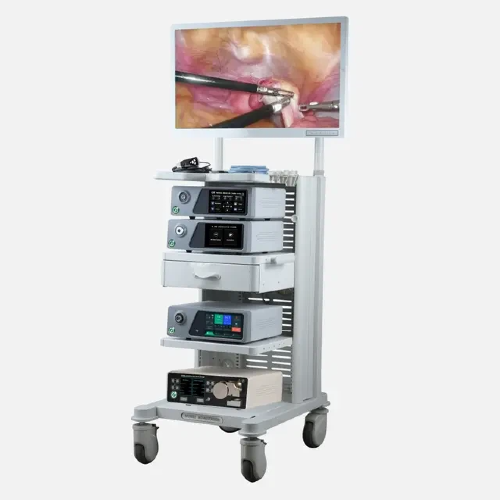
In endoscopy, lighting determines how well internal structures are visualized. LED and Xenon light sources remain the two primary technologies for 4K systems.
Feature | LED Light Source | Xenon Light Source |
Color Temperature | Adjustable (5600–6500K) | Fixed (~6000K) |
Lifespan | Up to 30,000 hours | Around 500 hours |
Heat Emission | Low | High |
Energy Efficiency | Excellent | Moderate |
Maintenance | Minimal | Requires periodic replacement |
LED illumination offers advantages in color consistency, energy consumption, and temperature control, making it safer for prolonged operations. Many advanced units also support dual-light modes, enabling surgeons to switch between narrow-band and full-spectrum illumination for tissue differentiation.
The 4K medical monitor is where the entire imaging chain culminates. These high-resolution displays reveal every texture, contour, and vessel with outstanding accuracy.
Modern displays employ IPS or OLED panels, which provide:
Wide viewing angles up to 178°, allowing multiple surgeons to observe simultaneously.
High contrast ratios exceeding 2000:1 for enhanced tissue differentiation.
Rapid response times that eliminate motion lag.
Anti-reflective coatings to minimize glare in operating rooms with strong ambient light.
Some monitors even incorporate split-screen modes and picture-in-picture displays, letting teams view endoscopic and patient data simultaneously—streamlining teamwork during complex procedures.
Beyond imaging, 4K Endoscope Camera Systems are becoming integral parts of digital operating room ecosystems. They seamlessly integrate with hospital IT infrastructure, allowing efficient data capture, transfer, and analysis.
Key features include:
Network connectivity (LAN/Wi-Fi) for data sharing between surgical departments.
Automatic recording and archiving for training and legal documentation.
DICOM compatibility, enabling connection with radiology databases.
Cloud-based storage for secure remote access and consultation.
The integration of touchscreen control panels and voice command systems enhances workflow ergonomics, reducing the need for manual interaction during sterile operations. These digital solutions allow medical teams to focus solely on patient outcomes.
4K imaging represents more than just higher pixel count—it redefines how surgeons interpret anatomy and perform procedures.
Benefit | Description |
Unmatched Image Clarity | Enables detection of micro-structures and lesions with high precision |
Enhanced Surgical Precision | Improves accuracy in incisions and tissue manipulation |
Reduced Procedure Time | Streamlines workflow and shortens operation duration |
Improved Training & Education | Offers crystal-clear visuals for medical teaching |
Patient Safety | Minimally invasive techniques lead to faster recovery and fewer complications |
These benefits also translate into better ergonomics for surgeons, as sharper images reduce eye fatigue and cognitive load during lengthy surgeries. Hospitals that adopt 4K systems often report higher diagnostic accuracy and postoperative success rates.
Feature | 4K Camera Systems | Full HD Systems | 3D Endoscope Systems |
Resolution | 3840×2160 | 1920×1080 | 1920×1080 (per eye) |
Depth Perception | Excellent via high contrast | Limited | Strong |
Image Sharpness | Very High | Moderate | High |
Color Reproduction | True-to-life | Slightly reduced | Good |
Cost | Higher | Moderate | Highest |
Application Fields | ENT, Urology, Laparoscopy | General Surgery | Neurosurgery, Robotics |
While 3D systems deliver depth perception, 4K technology strikes a superior balance between clarity, reliability, and cost-effectiveness. For most departments, 4K represents the ideal upgrade path from HD platforms.
The evolution of 4K endoscopy continues rapidly, driven by advances in artificial intelligence, robotics, and wireless technology. Key trends include:
AI-assisted visualization, identifying lesions and anatomical landmarks automatically.
Real-time 4K wireless transmission, enabling flexible OR setups without cable clutter.
Miniaturized sensors, reducing camera head size while maintaining image fidelity.
Integration with robotic surgery systems, improving precision in microsurgical applications.
Hybrid imaging systems, combining visible and infrared light for vascular mapping.
These technologies collectively make surgeries smarter, safer, and more adaptive, pushing medical imaging toward an era of intelligent visualization.
Choosing the appropriate 4K system requires careful consideration of both technical and clinical needs. Decision-makers should evaluate:
Sensor quality and color accuracy
Optical compatibility with existing endoscopes
Ease of sterilization and maintenance
System latency and data processing speed
After-sales technical support and upgrade services
Hospitals and medical centers should partner with experienced medical device manufacturers who specialize in precision imaging technology. A well-supported system ensures long-term stability, accurate calibration, and consistent performance across diverse surgical applications.
The core technology behind 4K Endoscope Camera Systems lies in the seamless integration of optical precision, sensor innovation, and intelligent digital processing. These systems provide surgeons with exceptional visual accuracy, enhancing diagnostic confidence and improving patient outcomes. As 4K imaging continues to set the new global standard for minimally invasive surgery, healthcare facilities are rapidly adopting this technology to achieve higher efficiency and safety.
For medical institutions or distributors seeking reliable, high-performance endoscopic imaging solutions, Xuzhou Hengjia Electronic Technology Co., Ltd. offers advanced 4K Endoscope Camera Systems designed for superior clarity, stability, and precision. Their expertise in optical and electronic engineering ensures solutions that meet the most demanding clinical requirements. To explore more about their latest 4K imaging technologies or to discuss customized cooperation, contact Xuzhou Hengjia Electronic Technology Co., Ltd. for professional consultation and partnership opportunities.


