


Views: 0 Author: Site Editor Publish Time: 2025-08-21 Origin: Site


Pediatric urology has seen significant advancements in recent years, yet it continues to face unique challenges due to the small size, delicate tissues, and developing anatomy of children’s urinary tracts. Surgical procedures in this population must carefully account for these anatomical differences, which directly influence the selection of instruments, surgical techniques, and perioperative strategies. In this context, Flexible Ureteroscopes have emerged as a critical tool in pediatric endourology. These instruments offer enhanced maneuverability through narrow and tortuous ureters, high-definition visualization for accurate diagnosis, and minimally invasive access that reduces tissue trauma. As a result, Flexible Ureteroscopes enable safer, more precise, and more effective diagnosis and treatment of a variety of pediatric urological conditions, including urinary stones, strictures, and congenital anomalies.
Flexible ureteroscopes allow pediatric urologists to perform procedures with minimal tissue trauma. Their small diameter and smooth maneuverability reduce the need for extensive incisions, which shortens recovery time and minimizes postoperative discomfort for young patients.
Equipped with advanced HD optics, flexible ureteroscopes provide clear, detailed visualization of the urinary tract. This enables clinicians to detect subtle lesions, stones, or strictures that might be missed with conventional imaging, improving diagnostic accuracy and treatment planning.
The flexibility of these ureteroscopes allows them to navigate narrow and delicate pediatric ureters with ease. This adaptability ensures access to challenging areas within the kidney and ureter, enhancing procedural efficiency and reducing the risk of ureteral injury.
By combining minimally invasive design and superior visualization, flexible ureteroscopes lower the risk of complications such as perforation, bleeding, or postoperative infections. This makes them particularly suitable for pediatric patients, where tissue sensitivity and long-term outcomes are critical.
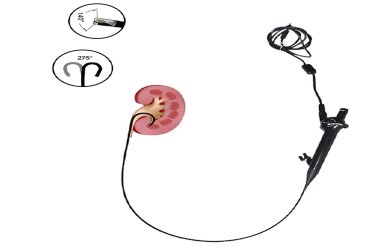
Modern flexible ureteroscopes are increasingly compact, specifically engineered for pediatric patients. Their reduced size allows safe navigation through small urinary tracts, minimizing trauma and enabling access to delicate structures that were previously challenging to reach.
Flexible ureteroscopes can be seamlessly combined with laser lithotripsy technology. This integration enables precise fragmentation of urinary stones, reducing procedure time and improving stone-free rates in children while maintaining a minimally invasive approach.
Advanced digital HD imaging provides high-resolution, real-time visualization of the urinary tract. This capability allows pediatric urologists to identify subtle lesions, strictures, or stones during complex procedures, enhancing both diagnostic and therapeutic accuracy.
Emerging single-use or semi-disposable flexible ureteroscopes reduce the risk of cross-infection and simplify sterilization processes. These innovations are particularly valuable in pediatric care, where infection prevention and rapid turnaround between procedures are critical for patient safety.
Flexible ureteroscopes allow minimally invasive access to the kidney and ureter for both diagnosis and treatment of stones. Combined with laser lithotripsy, they enable precise stone fragmentation, reduce operative trauma, and improve stone-free rates, even in small or difficult-to-reach areas.
Pediatric ureters are narrow and delicate, making stricture management challenging. Flexible ureteroscopes provide safe navigation for direct visualization, dilation, or endoscopic treatment of strictures while minimizing risks such as perforation or bleeding.
Children presenting with hematuria can benefit from flexible ureteroscopy for thorough examination. High-definition imaging helps detect small stones, tumors, or inflammatory lesions that may be missed with imaging alone, enabling early and accurate diagnosis.
Flexible ureteroscopes offer detailed inspection of anatomical variations or congenital anomalies in pediatric patients. This capability supports accurate diagnosis and guides individualized treatment plans, improving long-term outcomes and preserving renal function.
Designed specifically for the smaller ureters of pediatric patients.
Allows safer navigation with reduced risk of tissue trauma.
Facilitates access to narrow or tortuous urinary tracts that traditional scopes cannot reach.
Seamlessly combines flexible ureteroscopy with laser technology for efficient stone fragmentation.
Enables precise targeting of stones while minimizing collateral tissue damage.
Reduces procedure time and the need for multiple interventions.
Provides real-time, high-resolution visualization of the urinary tract.
Improves diagnostic accuracy for subtle lesions, strictures, or small stones.
Supports complex procedures by offering enhanced clarity for both surgeons and trainees.
Enables identification of stones, strictures, or anomalies at an early stage.
Facilitates timely treatment, preventing progression to more severe conditions.
Contributes to long-term preservation of renal function and reduced complications.
Reduces tissue trauma compared with open or rigid procedures.
Shortens hospital stay and recovery time, allowing children to return to normal activities sooner.
Decreases postoperative pain and overall patient discomfort, improving overall patient experience.
Procedures are adjusted based on the child’s age, ureter size, and anatomical variations.
Supports individualized planning for stone management, stricture treatment, or tumor evaluation.
Ensures safe handling and accurate outcomes by considering developmental and physiological differences in pediatric patients.
Explain the role of Flexible Ureteroscopes in pediatric urology procedures.
Discuss the procedure step-by-step, including preparation, anesthesia, and scope use.
Outline potential risks, benefits, and expected outcomes to set realistic expectations.
Address any questions or concerns from both parents and pediatric patients to reduce anxiety.
Provide instructions on maintaining hydration and diet to support recovery.
Explain warning signs such as hematuria, fever, or pain that require immediate attention.
Schedule and emphasize the importance of follow-up visits to monitor healing and detect recurrence.
Encourage proper hygiene and care of urinary catheters or stents if used during the procedure.
Educate families on the importance of adhering to follow-up schedules for optimal outcomes.
Use reminders and educational materials to reinforce care instructions.
Foster collaboration between families and healthcare providers to ensure continuity of care.
Flexible Ureteroscopes have become a cornerstone in pediatric endourology, driving innovation by enabling minimally invasive procedures with high precision. Their use improves patient safety, reduces procedural complications, and enhances clinical outcomes in the management of urinary stones, strictures, and other pediatric urological conditions.
Hospitals and clinics can further elevate the standard of care by adopting these advanced scopes and collaborating with trusted equipment providers to ensure reliable, high-quality instruments. Engaging specialized pediatric urology centers and following best practices with Flexible Ureteroscopes ensures children receive the safest, most effective treatment possible.


